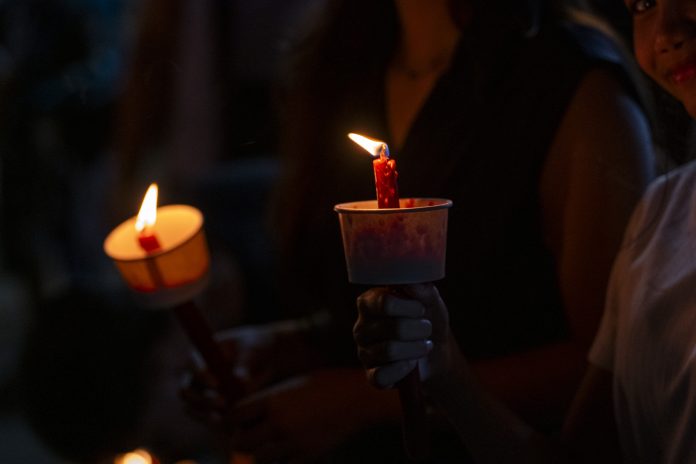
Instead of the image of an Easter bunny or an Easter egg, let me offer the image of one little candle for the Resurrection.
During the Martial Law protests leading to the People Power Revolution, there was one popular song that everybody was singing in churches, halls, and streets: One Little Candle. In the midst of the hopelessness and brutality of the Marcos regime, we were singing a song of hope with tears in our eyes.
“It is better to light just one little candle
Than to stumble in the dark
Better far that you light just one little candle
All you need is a tiny spark.”
“If we all say a prayer, then the world would be free
What a wonderful dawn of a new day we’d see
And if everyone lit just one little candle
What a bright world this would be.”
The Easter Vigil liturgies are all filled with candles in the dark. People bring home these little candles to signify that Jesus is risen. This, for me, is the meaning of the Resurrection. We do not have spotlights. All we have are small candles of hope.
Even as the Salubong scene has brighter lights, with small mounted angels singing Alleluia and the dark veil of Mary being taken down, the people still follow a dark processional route. It is dark. The difference is this: hopeful streaks of dawn shine on the horizon. A new day is about to start, a new perspective, a new light, a new vision.
Even the scriptural witnesses come in the same spirit. The disciples only saw the linen cloths. Mary Magdalene was still crying and thought he was the gardener. The apostles were still hiding until the Spirit came. Thomas was still doubting even on Jesus’ second visit. The two disciples in Emmaus only recognized him at the breaking of the bread, but he was gone.
When we go home and read the news, the war still continues. Bombs still fall. Prices are still up. The corrupt are still in their places. Political dynasties still cling to power. Those who killed the poor still have to answer for their crimes. Rich mining companies still abuse the land and Indigenous communities.
In our personal lives, the same problems continue. Old wounds still haunt us. Painful memories still disturb us at night. Quarrels persist, and no easy reconciliation comes. But we keep going because we know that one little candle in the dark—together—lights our path.
But there was a new light: they became more daring, more courageous, more confident. Their lives became signs of hope, telling the world that death is not the last word. Hope is.
Easter, in many countries, coincides with the season of spring, a sign of hope. Flowers blossom, shoots sprout, birds chirp, and light appears on the horizon.
The Easter liturgy is a liturgy of bodiliness and creaturely existence. There is a living eco-drama unfolding before our very eyes: darkness and light, water and oil, leaves and flowers, wine and bread. These symbols of God’s creation remind us that Jesus is risen. In the resurrection of Jesus, “the earth itself arose,” says St. Ambrose of Milan.
The lyrics of the Exultet, sung at the Easter Vigil, show this intimate connection between Jesus’ resurrection and the rejoicing of the whole cosmos. It is a hymn of heaven and earth proclaiming that Jesus is truly risen.
“Exult, let them exult, the hosts of heaven,
exult, let Angel ministers of God exult,
let the trumpet of salvation
sound aloud our mighty King’s triumph!
Be glad, let earth be glad, as glory floods her,
ablaze with light from her eternal King,
let all corners of the earth be glad,
knowing an end to gloom and darkness…”
On Easter, the tree of Calvary blossoms into the vibrant tree of life. In the apse of the Church of San Clemente in Rome is a cross depicted as a tree of life. The mosaic shows the whole of creation with the cross at its center—with doves and a fountain, feeding chickens and cattle, a grapevine, and a monk writing a book. The cross is truly a tree of life.
If there is one word to describe the Resurrection, it is hope. It makes the Cebuano in me say, “Padayon”—for “bisa’g hinay basta kanunay.”
Father Daniel Franklin Pilario, C.M., is the President of Adamson University in Manila. He is a theologian, professor, and pastor of an urban poor community on the outskirts of the Philippine capital. He is also the Vincentian Chair for Social Justice at St. John’s University in New York.