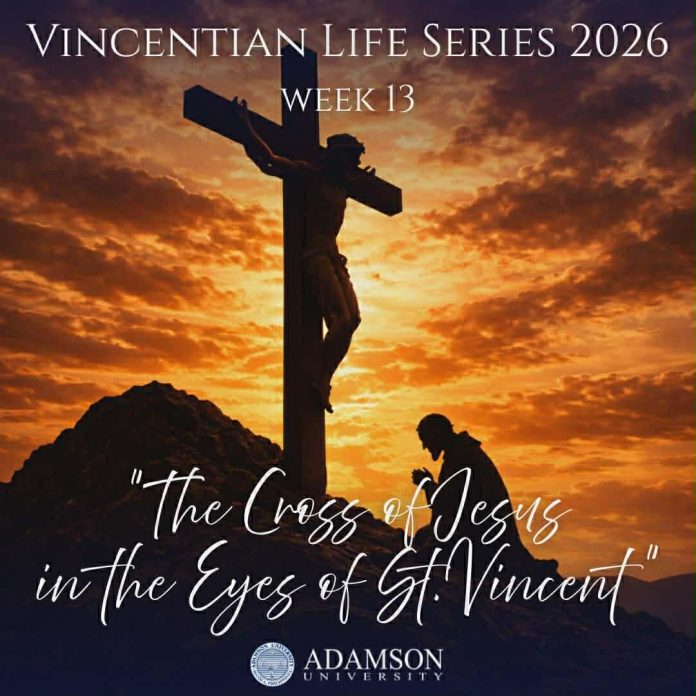
We are now entering Holy Week. We join the world in a week of prayer and reflection.
All the readings and liturgies of the Church recount the suffering, passion, and death of Jesus as he ascends to the city of Jerusalem. This is what he warns his disciples about, but which they repeatedly refuse to understand. “There is a cup that I need to drink from,” he told his disciples (Mk 10:35–45). He was talking about his passion and death on the cross.
As Vincentians, I would like to ask: How does the disciple Vincent de Paul appropriate this challenge into his life and ministry? How do we imitate Christ in his passion?
When responding to a Daughter of Charity on the theme of prayer, St. Vincent once said:
“Each one can take her stand at the foot of the Cross, in the presence of God and, if she had nothing to say to Him, let her wait till He speaks to her; if He should leave her there, let her remain there willingly and await from His bounty the grace of either speaking or of listening to Him.”
To stand at the foot of the Cross, to talk to Him, and to wait for what God wants to say — that is what Vincent wants us to do. There is so much in the passion of Jesus that he wants to tell us. For St. Vincent, as for St. Louise de Marillac, “the charity of Christ crucified urges us.”
In another conference, he told his priests:
“Let’s meditate on all that, Messieurs; we’ll find stupendous acts of gentleness, which surpass human understanding. Let’s also consider how He maintained this gentleness everywhere. They crown Him, they burden Him with His Cross, they stretch Him out on it, they hammer the nails into His hands and feet; they raise Him up and drop His Cross violently into the hole they had prepared for it; in a word, far from mingling any gentleness with all that, they treat Him as cruelly as possible.
“There He is in that horrible torment, a torment I ask the Company to judge by the weight of His body, the stretching of His arms, the roughness of the nails, the number and the nature of His pierced nerves.
“What does He say on the Cross? Five words, and not one of them shows any impatience. He says clearly, ‘Eli, Eli, Father, Father, why have you abandoned me?’ But this isn’t a complaint; it’s an expression of tormented nature, suffering agony with no consolation. The superior part of His soul acquiesces gently to this; otherwise, having the power to overthrow this rabble and cause all of them to die and to free Himself from their hands, He could have done it, but He didn’t. O Jesus, my God! What an example for us who have committed ourselves to imitate You. What a lesson for those who are unwilling to suffer anything!”
True to the medieval devotion of his times, Vincent’s spirituality was also centered on the emotional, physical, and visceral experience of Jesus on the cross — also present in the devotions to the crucifixion and death of Jesus prevalent in baroque Christianity in the Philippines.
But beyond the emotional focus on the cross of Jesus and his physical suffering, Vincent wants us to go further. He wants us to imitate Jesus in his whole life — not only in his suffering and death.
There is a Latin phrase that is most important to St. Vincent: “Quid nunc Christus?” — What would Christ do now, if he were in my shoes?
The most important question for Vincent is how to follow Jesus — not only in his passion and death but also in his life; not only in the end but also from the beginning, especially in his public ministry; not only in the Paschal Mystery but also in the proclamation of God’s Kingdom to the poor.
In the mind of St. Vincent, there is one aspect of Jesus’ life that strikes him as very important — his work of evangelizing the poor. It is because of his ministry to the poor and his defense of them that he was killed on Calvary. In short, Jesus’ passion for the poor led him to his own passion on the cross.
He told his missionaries what their main mission is:
“The intention of the Company is to imitate our Lord to the extent that poor, insignificant people can do… It means that the Company aspires to take Him as a model in the way He acted, what He did, His ministries, and His aims.”
“Our Lord asks us to evangelize the poor; that’s what He did, and what He wants to continue to do through us. We have a great reason to humble ourselves here, seeing that the Eternal Father is using us for the plans of His Son, who came to preach the Gospel to poor persons, giving them as a sign that He was the Son of God and that the long-awaited Messiah had come.”
To preach the Gospel to the poor, to work for justice and equality, to transform the world so that the poor shall no longer be excluded and marginalized — these are the signs that the “Son of God and the long-awaited Messiah has come.” And we are unworthy servants whom God uses to bring about this plan of the Father. What a noble vocation Vincentians have.
This is so important to Vincentian spirituality that St. Vincent chose these programmatic words in the Gospel of Luke as the motto of the Congregation of the Mission — “Evangelizare pauperibus misit me.”
“The Spirit of the Lord is upon me, because He has anointed me to bring glad tidings to the poor. He has sent me to proclaim liberty to captives and recovery of sight to the blind, to let the oppressed go free.” (Lk 4:18)
For St. Vincent, dying to ourselves on the cross means carrying our little crosses by giving our own lives willingly to our neighbor as He gave His own. Like Jesus, our own paschal mystery is found in humbly serving our sisters and brothers, especially the poor.
He once wrote to a priest in the mission:
“I beg Our Lord that we may be able to die to ourselves in order to rise with Him, that He may be the joy of our heart, the end and soul of our actions, and our glory in heaven. This will come to pass if, from now on, we humble ourselves as He humbled Himself, if we renounce our own satisfaction to follow Him by carrying our little crosses, and if we give our lives willingly, as He gave His, for our neighbor whom He loves so much and whom He wants us to love as ourselves.”
And our “little crosses” do not just mean our toothaches, diabetes, or marital woes. They refer to the consequences of commitment to help “our neighbor,” especially the downtrodden.
One Latin American theologian, Ignacio Ellacuría — who was also murdered by the military forces of his country, El Salvador, for defending the oppressed — once wrote an article entitled “Why Was Jesus Killed?” He said that our question should not be “Why did Jesus die?” (to which many will answer “to save us from sin”). The right question should be: “Why was Jesus killed?” The answer: He was killed because He served the poor and defended their cause.
In short, it is Jesus’ preferential option for the poor that led Him to His death on the cross. His commitment to the kingdom of equality, freedom, and justice made Him say and do things that challenged the social, political, and religious structures of His society. His crucifixion was the necessary consequence of such a commitment. The question is not just why Jesus died. The deeper question is why He was killed.
To “stand at the foot of the cross” — to which St. Vincent invites us — is thus both an act of defiance against oppressive powers that kill the poor and a necessary consequence of our life’s commitment to preach the Good News to them, no matter what it takes.
Father Daniel Franklin Pilario, C.M., is the President of Adamson University in Manila. He is a theologian, professor, and pastor of an urban poor community on the outskirts of the Philippine capital. He is also the Vincentian Chair for Social Justice at St. John’s University in New York.