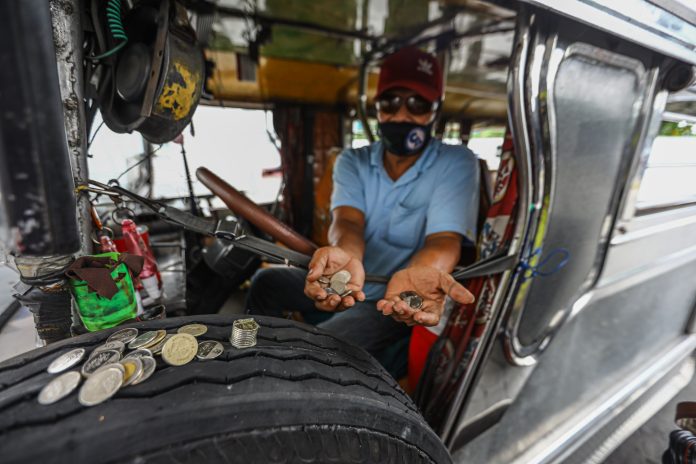
Transport group Piston warned that escalating US–Israel military attacks on Iran could drive up fuel prices and endanger millions of Filipino families reliant on overseas workers in West Asia.
In a statement, Piston said it “vehemently condemns the US-Israeli military attacks on Iran,” warning that the conflict threatens “severe economic devastation on Philippine transport workers and millions of OFW-dependent families.”
The group said the Philippines’ dependence on imported crude oil leaves the country exposed to geopolitical shocks.
“The Philippines imports 100% of its crude oil requirements, with 77% originating from countries now directly embroiled in the conflict as hosts of US military bases,” it said.
Piston noted that pump prices “have already risen sharply since January — with diesel up by over P9.00 per liter,” and warned they “are projected to spike further as the Strait of Hormuz, through which 30% to 40% of Philippine oil imports flow, becomes a militarized zone.”
It added that every $10 increase in global crude prices translates to an additional P2.50 to P4.00 per liter at local pumps, a cost that deregulated oil companies automatically pass on to consumers, while the government remains constrained by three decades of privatization under the Oil Deregulation Law.
The group also raised concerns about the situation of Filipino migrant workers in the region.
“Furthermore, the situation of approximately 1.5 to two million OFWs in West Asia raises serious alarm,” Piston said, noting that these workers “contribute 25% to 30% of total OFW remittances comprising eight to nine percent of national GDP.”
It warned that “Even if only 10% of these workers are displaced, the resulting humanitarian crisis would affect 150,000 to 200,000 Filipinos, with economic repercussions extending to nearly one million family members domestically.”
Piston added that the potential loss of $500 million in income over six months, combined with oil shock inflation that costs the poorest 10% of households nearly three percent of their incomes, creates domestic volatility closely tied to war-driven disruptions abroad.
The group also linked the conflict to the Philippines’ security arrangements with the United States.
It said the Enhanced Defense Cooperation Agreement has transformed the Philippines into what it described as a forward operating base for US imperialism, with American troops maintaining facilities in nine locations and deploying missile systems and drone operations from Mindanao to the West Philippine Sea.
Piston added that recent attacks on US installations in West Asia show that hosting American military infrastructure invites retaliation rather than security, and said the Marcos Jr. administration’s expansion of US military presence ignores this lesson and continues to endanger the Filipino people.
Piston called for “an immediate end to all military operations against Iran,” the “complete withdrawal of US troops and weapons from the Philippines,” “the comprehensive evacuation and livelihood support for affected OFWs,” the “immediate scrapping of VAT and excise tax on petroleum products,” and “the nationalization of the oil industry to establish genuine price controls.”
Meanwhile, Katribu Kalipunan ng Katutubong Mamamayan ng Pilipinas also condemned the attacks, saying it “condemns the joint military strikes launched by the United States and Israeli governments against Iran.”
The group described the strikes as “the latest act of aggression” that “further destabilizes West Asia and drags the region deeper into a widening war driven by imperialist interests and Zionist militarism.”
Katribu warned that the escalation “gravely endangers our Filipino compatriots working in Iran and across West Asia and North Africa (WANA).” It said, “Thousands of overseas Filipino workers, including Moro and Indigenous Peoples in the region, face insecurity, displacement, and loss of livelihood as tensions rise.”
The group also cited military agreements between Manila and Washington, saying “The expansion of the United States’ military presence in the Philippines, through the Enhanced Defense Cooperation Agreement (EDCA) and other military agreements, places our country at greater risk of being drawn into wars that do not serve the interests of the Filipino people.”
Katribu called on the government “to reject involvement in any military maneuver that supports US-led aggression” and said it joins “the global community in demanding an immediate halt to hostilities and accountability for violations of international law.”