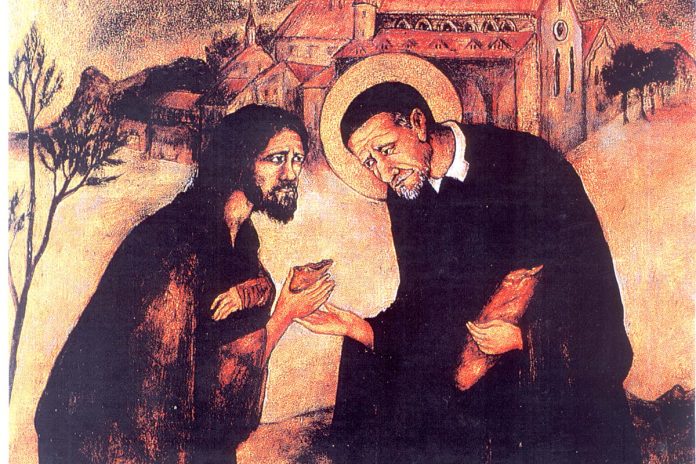
Have you heard that St. Vincent was once sold as a slave?
From 1605 to 1607, for around two years, we did not hear from the young priest Vincent. After that failed parish assignment, where did he go? Then, after two years, on July 24, 1607, he wrote quite a long letter from the city of Avignon to Monsieur de Comet, the benefactor of his youth.
“I was sold to a fisherman,” Vincent’s long letter goes, “but as I have always been a bad sailor, he was soon obliged to get rid of me to an old alchemist.”
Let me recount the long story as he himself narrated it.
Impulsive as he was, Vincent was still in pursuit of his youthful dream: to seek “opportunities for advancement.” He found out that there was a good old lady who made a last will in his favor, that is, some parcels of land, furniture, and a good sum of money.
In order to claim this, he set off at once. But when he arrived at the place, the man to whom the fortune was left had already run off to Marseilles, which was quite far away. He decided to pursue him and, since he had no money, he sold his borrowed horse. He finally caught up with him in Marseilles and got the money.
When he was about to go back to Toulouse, he was persuaded by someone to return by boat since there was good weather that season. “I did this to get there sooner and cheaper,” Vincent wrote, “but as it turned out, I never arrived there, and I lost all I had.”
On the high seas, three Turkish boats attacked them, killed some of them, and put the rest in chains. After looting the boat, they landed on the Barbary coast. Barbary refers to the areas beyond the Mediterranean, the lands of North Africa, modern-day Tunis, Algiers, and Morocco.
When they landed, all the captives were stripped naked and made to march around in chains for buyers to inspect them.
“Like a horse or an ox is inspected at a sale,” he wrote, “they made us open our mouths to show our teeth, felt our sides, probed our wounds, made us walk, trot, run, carry a pack, and wrestle with each other to show our respective strengths, and made other brutalities besides.”
Vincent was sold to a fisherman. But no sooner was he resold to an alchemist, a natural doctor who worked with melting metals, turning silver into gold, supposedly in search of the “philosophers’ stone.” “My work was to keep the fire going in the 10 to 12 furnaces,” Vincent narrated. He remained there for almost a year. The man was fond of Vincent, as he shared his secrets with him and promised him “great riches.”
But the alchemist died and, like any other slave, Vincent was passed to a “renegade,” an apostate from the faith who had converted to Islam earlier. Vincent was moved to a warm mountainous area. The apostate had three wives, and one of them was curious to learn about his Christian practices. She made him sing praises to God, which drove him to tears like the Babylonian slaves who hung up their harps, as the Psalmist declares.
This woman convinced her husband that it was wrong to abandon his religion. When they decided, they took a small boat back to the continent. There, the apostate was reconciled to the Church. He returned to Rome and entered a religious community. Vincent went with him and was promised, for another time, a “good benefice” by a certain Monsignor who was also fond of him and his “antics.”
“Knowing that I am a churchman,” Vincent continued, “he has ordered me to send for my ordination papers, promising to stand by me and to obtain a benefice for me.” This is the reason why he was writing to Monsieur de Comet. He needed some help to get his papers.
“I am in this city of Rome where I continue my studies… who does me the honor of esteeming me and desiring my advancement, because I was able to show him many curious things which I learned during the time I was a slave of the old Turk to whom I was sold.”
Why the intense interest? “His affection for me and his good will have given me hope, and he has promised me a successful and honorable issue to my affairs in the shape of an honest benefice in France.”
This letter was totally forgotten, and Vincent did not say anything about what he wrote there. When someone found it in 1658, two years before his death, the old Vincent wanted to get hold of it and destroy it. But the original copy existed somewhere and was given to Vincent’s secretary. This is where we got our story.
But why did Vincent try to hide these two years of his life? What was he hiding from his followers?
His biographers and followers are divided on the issue. Some authors believe that he was covering up his self-indulgent youth by “inventing” this narrative to Monsieur de Comet. We have to remember that he got a large amount of money as inheritance from that lady in Marseilles. Those authors argue that he might have spent this big fortune somewhere without a trace.
Many others, however, think that the story really happened and that Vincent really became a slave in Tunis. First, the letter authentically came from Vincent. He did not disprove it. He only wanted to destroy it. But why?
Maybe he did not want his followers to know that their founder had been engaged in some sort of “black arts.” Alchemy was considered satanic in medieval times, and a cleric of good standing should have nothing to do with it. In fact, Pope John XXII threatened with excommunication any ecclesiastic who practiced it.
This position explains many things in the life of St. Vincent, for example, his malaria-like fever, which he might have caught in the harsh climate of Tunis, and his knowledge of alchemy and various natural cures, which later in his life he mentioned to the Daughters of Charity.
But what do we learn from this episode of Vincent’s life?
Setbacks can also be graced moments. They are opportunities for learning. Life events are not random occurrences. They are part of the greater scheme of things in God’s plan.
In his would-be missionary endeavors, Vincent’s decisions presupposed a deep knowledge of the North African terrain in Tunisia and Algiers. In these missions, for instance, he asked the missionaries to set up a post office and bank so that the captives could establish contact with their families. He knew first-hand how hard a captive’s life could be. His close engagement with the galley slaves, most of whom came from those colonial places, was doubtlessly prepared by his own experience of slavery.
In God’s providence, most often without our knowing, His hands guide our paths and prepare us for His mission.
Father Daniel Franklin Pilario, C.M., is the President of Adamson University in Manila. He is a theologian, professor, and pastor of an urban poor community on the outskirts of the Philippine capital. He is also the Vincentian Chair for Social Justice at St. John’s University in New York.