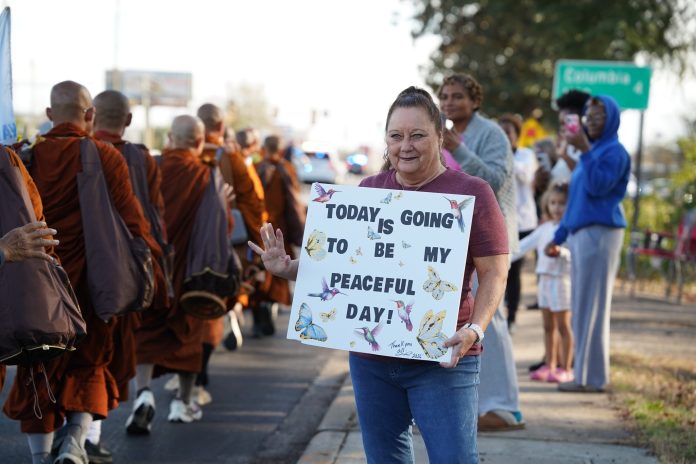
On Feb. 11, after 108 days and nearly 3,700 kilometers, a delegation of Buddhist monks arrived in the United States capital, concluding a cross-country “Walk for Peace” that began in Fort Worth, Texas.
What started as a modest spiritual exercise on October 26, 2025, transformed into a national phenomenon, captivating hundreds of thousands through social media and reawakening dialogue on the power of nonviolence.
For the global Catholic Church, this pilgrimage echoes the prophetic call of Pope Leo XIV, who in September 2025 renewed the plea for human fraternity.
The pope emphasized that authentic faith must serve as a bridge, urging religious leaders to build a “future of peace, fraternity, and solidarity.”
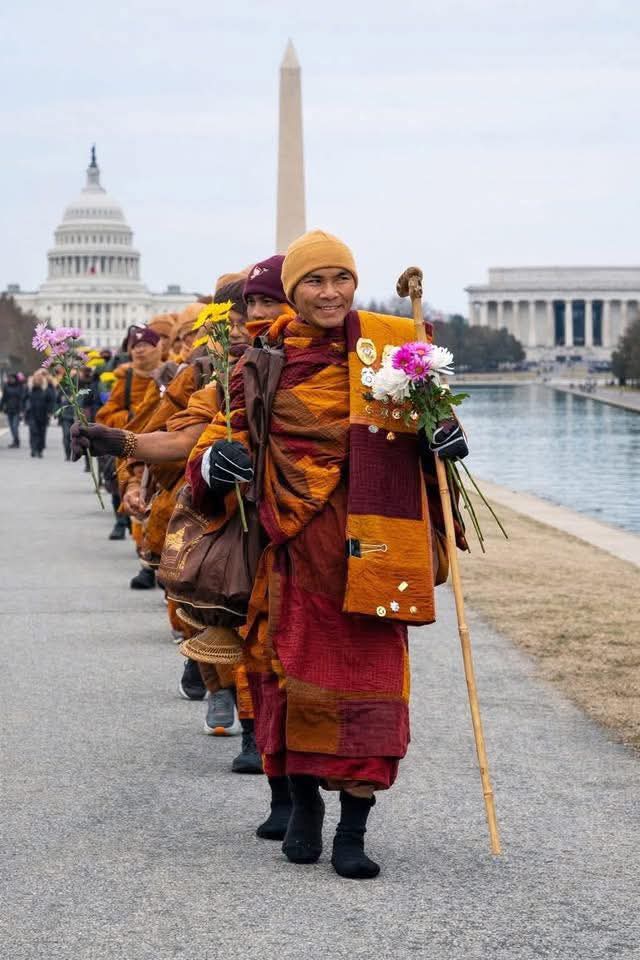
In the silent, mindful steps of these monks, observers see a living translation of the pope’s vision, a “prayer in motion” navigating the social tensions of modern urban life.
The journey’s most profound moment occurred not in a cathedral, but on a highway in Dayton, Texas. On November 19, a tragic accident involving a pickup truck left Venerable Maha Dam Phommasan, abbot of a Thai temple in Georgia, with injuries that led to the amputation of his leg.
His response has become a touchstone for interreligious reflection. Speaking from his hospital bed, Maha Dam offered his pain as a gift:
“Losing a leg is a sacrifice I don’t mind making if it helps spread peace, love, hope, compassion, harmony, and kindness.”
For Catholic observers, this radical embrace of tragedy mirrors the theology of redemptive suffering. “To see such a radical embrace of personal tragedy for the sake of a greater communal good is a profound witness,” noted a lay member of an interfaith dialogue group. “It is the Beatitudes in action.”
Led by Thai Venerable Bhikkhu Pannakara, the group, representing traditions from Thailand, Laos, Taiwan, and Vietnam, has relied entirely on the hospitality of strangers.
Traveling with few belongings and often walking barefoot to maintain a connection with the earth, they have practiced Vipassana, an ancient meditation technique focusing on the impermanence of suffering and the cultivation of mindfulness.
While the group plans to meet with lawmakers to discuss the recognition of Vesak, they insist the walk is not an act of political advocacy. Long Si Dong, a spokesperson for the temple, described it as a “spiritual offering.”
“We believe when peace is cultivated within, it naturally ripples outward into society,” he said.
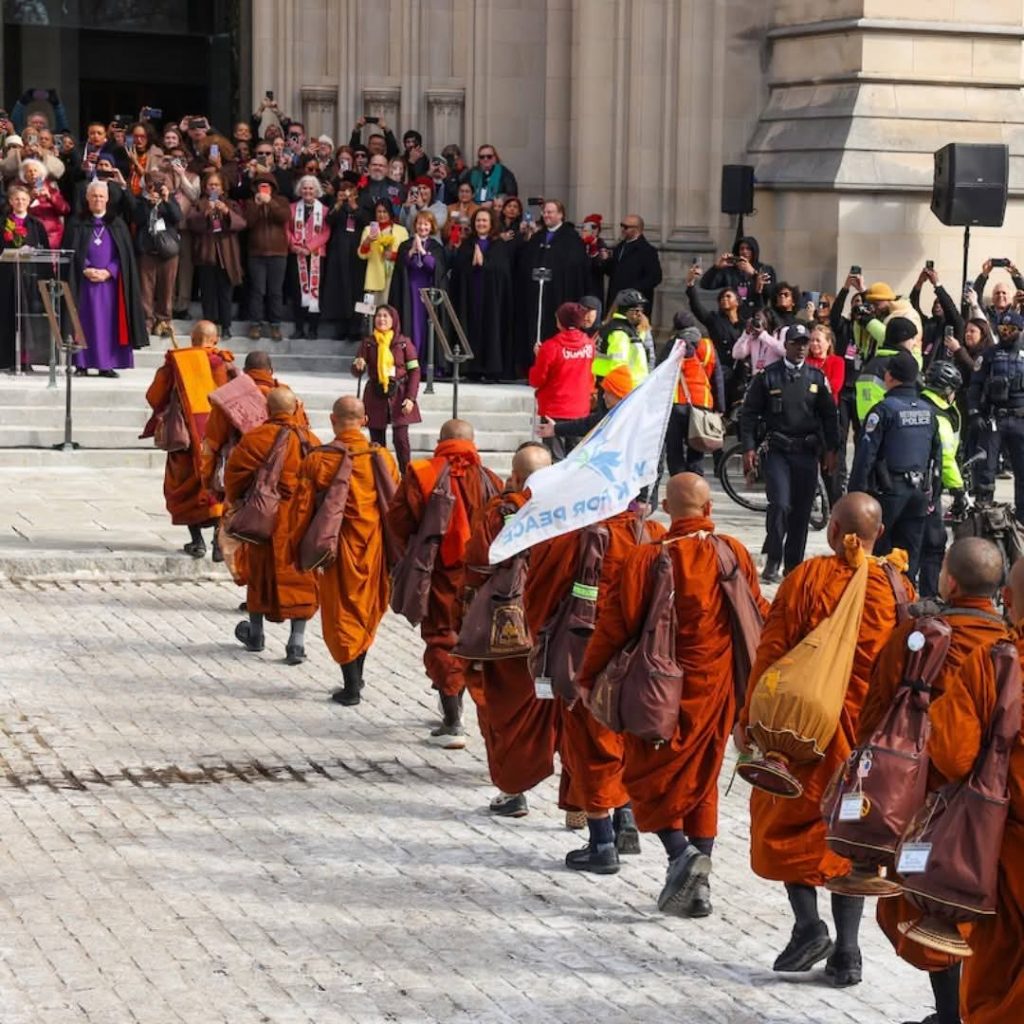
The pilgrimage reached a crescendo on February 10 at the Washington National Cathedral. Flanked by Most Rev. Mariann Edgar Budde, Episcopal bishop of Washington, and other faith leaders, the monks stood before thousands.
“This walk could change our life,” Pannakara told the crowd. “How many of us are willing to walk to bring world peace?”
The sight of Maha Dam Phommasan, rejoining his brothers in a wheelchair to enter the arena at American University, served as a poignant reminder of the physical cost of their message.
Despite the hostility they occasionally encountered on the road, their response remained a simple, repeated blessing: “May you be well, happy, and peaceful.”
As the monks prepare for their return bus journey to Texas this weekend, they leave behind a trail of humanistic encounters.
Their final act will be a 9.6-kilometer walk back to the Huong Dao Vipassana Bhavana Center, completing a circle of grace that proved, even in a divided age, that peace is a path best walked together.