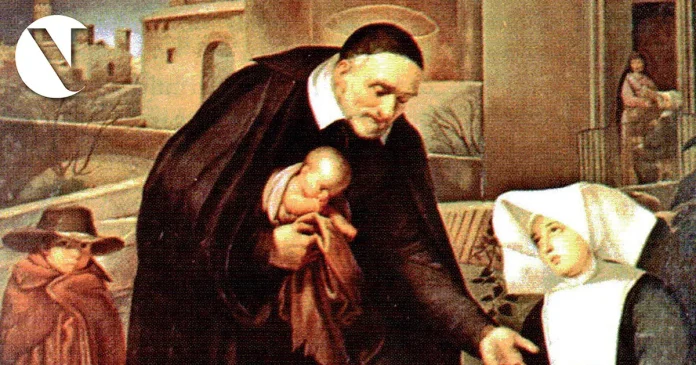
St. Vincent was not a “saint” from childhood. He was like any other ordinary young person, full of dreams for himself and his family. He was not an evil or vicious man, but neither was he a saint who had totally offered his life for the poor. He was just like the rest of us.
On February 17, 1610, at the age of 29, the young priest Vincent wrote his mother a revealing letter. He wrote about his search for “opportunities for advancement” toward a “modest pension” and an “honorable retirement.” For a priest of ten years, and for one who had not even worked as a pastor (he had never been assigned to a parish), it is quite strange to hear such a motive.
“Mother,” he wrote, “the prolonged sojourn which I must necessarily make in this city (Paris) in order to regain my chances of advancement (which my disasters took from me) grieves me, because I cannot come to render you the services I owe you. But I have such trust in God’s grace that He will bless my efforts and will soon give me the means of an honorable retirement, so that I may spend the rest of my days near you.”
Then he continued to talk about his brothers and sisters: “I should very much like to know how things are at home, and whether all my brothers and sisters and other relatives and friends are well, especially whether my brother Gayon is married and to whom…”
“I should also like my brother to have one of my nephews study. My misfortunes and the little service that I have as yet been able to render at home may make him unwilling to do so, but let him reflect that the present misfortune presupposes good luck in the future.”
Reading this letter to his mother gives me the impression of a loving son who is quite caring and concerned about his family: whether his brother is already married and to whom; where his sister was living; whether his nephews were studying; how his other relatives were doing. It reads like a young man missing his siblings after not having come home for a long time. For all of us, family is a fundamental source of life’s strength and direction, and not having heard from them for a long time weakens it.
The letter also expresses Vincent’s first motivation: to be able to augment his family’s resources. “I cannot come to render you the services I owe you,” he tells his mother. We have to remember that his father had to sell their oxen, an important resource in an agricultural village, so that Vincent could pursue his studies for the priesthood. Now, his father was gone. And he, having been ordained to the priesthood, had not come back to help them because of his “misfortunes,” as he sadly acknowledged. Ten years had passed and nothing had happened.
Yet Vincent was persistent, as he always was. “Present misfortune,” he writes, “presupposes good luck in the future.” What were these “misfortunes” as he sought opportunities for advancement? We try to unravel these in the next stories.
If you look at Vincent’s attitude deeply, these are not evil aspirations. In fact, they are natural desires of a caring person. Moreover, these are the motivations of an ordinary young man wanting to improve his socio-economic situation and that of his family.
However, this is far from the St. Vincent who fully offered his whole life to the poor. To strive for personal opportunities for advancement, to seek a modest pension through the priesthood, to desire retirement this early in one’s career “so that I may spend the rest of my days near you” — these are attitudes of a young, ambitious priest seeking personal gain and self-fulfillment.
Priesthood was for him more of a career than a vocation, more of an achievement than service.
Later in life, Vincent wrote: “How wretched are those who enter the ecclesiastical state by the window of personal choice and not by the door of a genuine vocation.”
All of us need some sort of conversion, a change of life from one state to another. Some need conversion from deeply evil ways to a good life. Others need to move from being obsessed with self-seeking motives to an other-oriented life.
Vincent was not a bad priest. But God called him slowly to change, from a life seeking career opportunities and self-advancement to a life truly offered for others, a life no longer centered on family relations but on the poor.
There are people like Saul of Tarsus who were suddenly stopped in their evil plans after being struck by a blinding light as he fell to the ground. Then and there, through God’s sudden flash of grace, he was converted and began to live a new life.
But like many of us, Vincent’s conversion was a slow process of God guiding him into God’s embrace and into the world of the poor through a complex labyrinth of life events.
Father Daniel Franklin Pilario, C.M., is the President of Adamson University in Manila. He is a theologian, professor, and pastor of an urban poor community on the outskirts of the Philippine capital. He is also the Vincentian Chair for Social Justice at St. John’s University in New York.