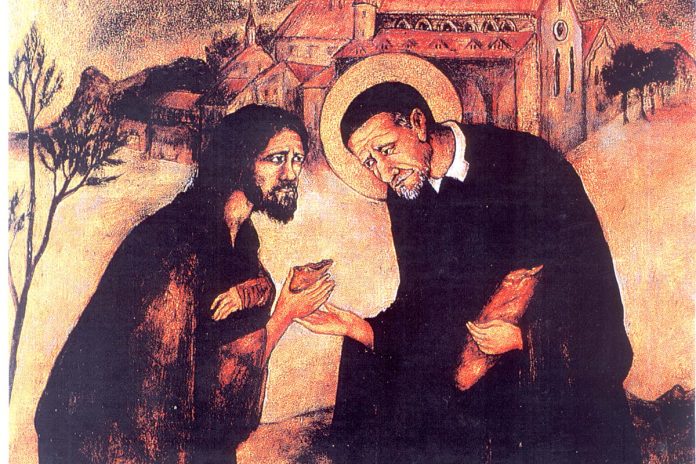
In front of Vincentian Hills Seminary in Angono, Rizal, one will see a statue of Vincent de Paul, less than five feet tall, looking like a hunchback, stocky and with a physique not proportional to an ordinary Frenchman of our times. My other impression of St. Vincent is a bearded old man, not smiling and not accessible, with a strict look projecting a sense of seriousness and rigidity, a feature found in many of his statues and portraits. So, how does St. Vincent really look?
Let us listen to the account of his first biographer, Louis Abelly, who was his contemporary and lived with him in St. Lazare.
“Monsieur Vincent was of medium height and well-proportioned. His head was rather bald and large, but well-made and in proportion to the rest of his body. The brow was broad and majestic, the countenance neither too fat nor too thin. His aspect was mild, his eye penetrating, his hearing acute, his bearing grave, his gravity benign, his countenance open and simple. He was most accessible and of a marvelously kind and amiable disposition. He was of bilious and sanguine temperament and his health fairly strong and robust.”
He was not, therefore, a short man but of medium height. His body was well-proportioned, neither too fat nor too thin. It might be true that he had the distinguishable features of a southerner. Dax, his birthplace, is in the south of France. These include a large nose, long ears, strongly marked brows, and a powerful chin.
But what makes his personality naturally attractive is more than his physical features: his open and simple face, his kind and friendly character. His penetrating eyes express both the fire and the gentleness in his person, which could easily create an impact on his audience.
Most of his portraits show an old man of frail health and seemingly limping all the time. But this is the image of St. Vincent two years before his death.
Louis Abelly described him earlier in his life: “His health was fairly strong and robust.” If Vincent were a frail and sickly type, how could one explain the physical stamina he had, which his numerous works at the height of his pastoral ministry demanded?
He was not exempt from illnesses, of course. When visiting his confrere missionaries in the infirmary of St. Lazare, he encouraged them by alluding to his own sicknesses.
“Don’t be afraid, brother. I had that illness when I was young and was cured of it. I used to suffer from breathlessness and do so longer. I have also suffered from hernia and God has cured me of it. I have had violent attacks of headache, lung and stomach troubles from which I have recovered. So just have a little patience.”
He suffered from what was then called “tertian fever,” which he lovingly called “my little fever,” an intermittent fever like malaria that recurs every third day, characterized by chills and sweating, caused by some virus.
In 1615, at the early age of 34, he was attacked by a grave illness in the legs, making him limp for the rest of his life. In 1631, when he was 51, he was afflicted with a serious disease that worsened through the years.
In 1658, his carriage broke down and his head struck the pavement with great violence. This caused a severe attack of fever and, with all other complications, led to his deathbed two years later.
In her letters, Louise de Marillac, who was concerned about his health, always suggested some remedies for these illnesses. These existential experiences provide the basic ground that made Vincent understand the situation of the sick poor, who occupied a special place in his heart and ministry.
Despite his physical frailties, his moral and missionary vigor remained intense. He still attended to his numerous works when these diseases afflicted him. It was even during these moments that most of his conferences were given. His day was filled with pastoral concerns from four o’clock in the morning to late in the evening. Here is a man with physical frailties, like the rest of us, but exceptionally passionate about the work of the Lord.
In the later part of his life, he still thought that he was not exempt from going to the missions and preaching the Gospel.
“I myself, old and sick as I am, should not cease to be disposed, yes, even to set out for the Indies to win souls for God, even though I were to die on the way, or on board a ship. For what do you think God asks of us? A body? Oh, not at all. What then? Our good will, a genuinely good will to seize every opportunity to serve him, even at the risk of our lives.”
“As for myself, in spite of my age, I say before God that I do not feel exempt from the obligation of working for the salvation of poor people, for what could hinder me from doing so? If I cannot preach every day, all right. I will preach twice a week. If I cannot preach more important sermons, I will strive to preach less important ones. And if people do not hear me, then what is there to prevent me from speaking in a friendly, homely way to those poor folk, as I am now speaking to you, gathering them around me, as you are now.”
What relevance does this have for our search for Vincent?
Knowing Vincent de Paul in his flesh and blood brings down the lifeless saint from the pedestal people have created for him. He is no mere woodwork, beautiful but unrealistic. No, he is too human and frail, like the rest of us.
Yet in the midst of his bodily weakness and the depth of his human frailty shine sparks of God’s work and divine strength in his life.
Father Daniel Franklin Pilario, C.M., is the President of Adamson University in Manila. He is a theologian, professor, and pastor of an urban poor community on the outskirts of the Philippine capital. He is also the Vincentian Chair for Social Justice at St. John’s University in New York.