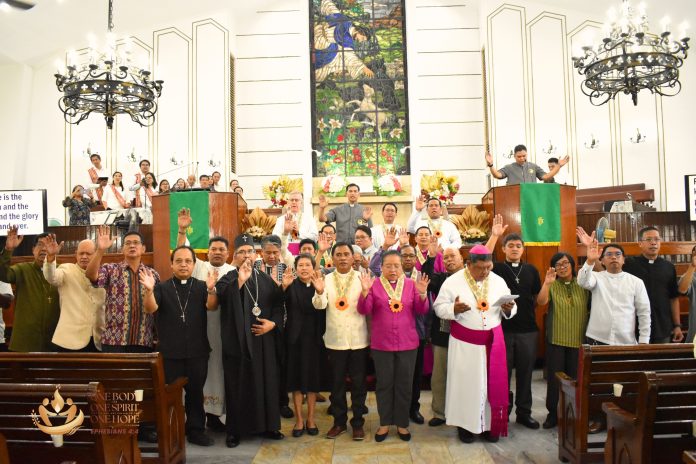
Ecumenical church leaders in the Philippines said Christian unity must be lived through collective action against injustice, environmental destruction, and democratic decline, emphasizing moral responsibility and public witness.
The statement, titled “One Body, One Spirit, One Hope,” situates Christian unity within political and ecological realities, as churches released it for the 2026 Week of Prayer.
It was signed by Bishop Mel Rey M. Uy of Lucena, chairperson of the Episcopal Commission on Ecumenical Affairs of the Catholic Bishops’ Conference of the Philippines, and Minnie Anne Mata-Calub, general secretary of the National Council of Churches in the Philippines.
“As we enter the year 2026, we look upon our nation with ‘the eyes of the heart’ (Eph. 1:18), and discern a landscape marked by both immense struggle and resilient faith,” the statement said.
The leaders stressed that the churches “do not pray in a vacuum,” grounding their call to unity in lived realities shaping the daily experiences of Filipino communities across social, political, and economic divides.
On economic conditions, they said, “We witness the widening gap between the few who control the nation’s wealth and the many who toil for a pittance,” pointing to deepening inequality nationwide.
The leaders added that calls for genuine land reform and a living wage are “not merely secular concerns,” but “spiritual cries for the ‘daily bread’ promised by our Lord.”
Church leaders also raised concerns about the political climate, saying national sovereignty and human dignity are “often traded for geopolitical interests” amid a “shrinking space for democratic dissent.”
The statement cited a “persistent culture of impunity” as a challenge confronting governance, warning that such conditions undermine accountability and weaken the moral foundations of public life.
On environmental and land issues, the ecumenical community pledged to defend ancestral lands and maritime territories from destructive development practices affecting Indigenous communities and fragile ecosystems.
“We oppose destructive large-scale mining and other forms of development aggression that displace Indigenous Peoples, destroy biodiversity, and prioritize profit over planet,” the statement read.
The document added that the churches recognize “the ‘one hope’ of our calling includes the healing of our wounded earth,” linking ecological care directly to Christian discipleship.
Human rights advocacy was described as central to unity, with churches pledging to be “sanctuaries for the oppressed and voices for the voiceless” across the country.
They committed to protecting human rights defenders and pursuing “a just and lasting peace that addresses the root causes of armed conflict—poverty, landlessness, and injustice.”
The leaders rejected symbolic expressions of unity detached from social realities, declaring, “We therefore reject a ‘cheap unity’ that ignores social contradictions.”
Instead, it called for a “costly unity” that “bears the cross alongside the suffering Filipino people,” grounding ecumenical witness in solidarity with marginalized communities.
Drawing inspiration from the World Council of Churches and its “Pilgrimage of Justice, Reconciliation, and Unity,” the leadersaffirmed that church unity is inseparable from the unity of humanity and integrity of creation.
The Philippine churches said they would not return to “business as usual,” but commit to sustained unity in action and public witness.
“Our unity is our strongest witness,” they said, adding that standing together for truth and walking with the marginalized reveals “one Body, one Spirit, and one Hope.”