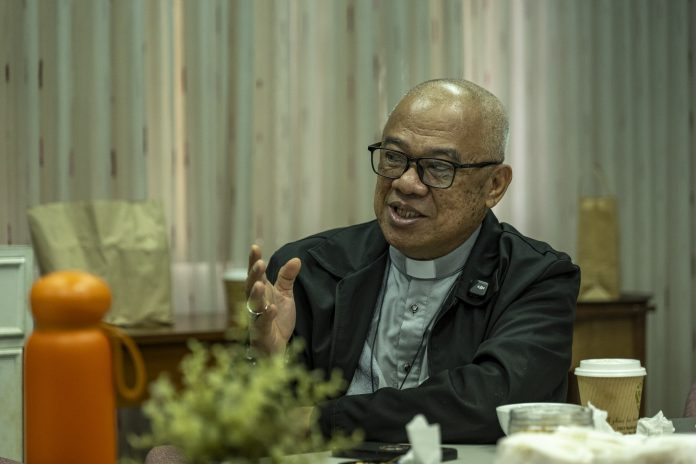
The bishop of San Carlos in the central Philippines said the proposed 2026 national budget should be read as a moral document that reveals the country’s true priorities.
Bishop Gerardo A. Alminaza, who heads Caritas Philippines, said budgets go beyond numbers and policy choices. He urged Catholics to assess public spending through faith, conscience, and care for creation.
“The national budget is not merely a technical or political document. For people of faith, it is a moral document. It reveals what a nation truly values, whom it chooses to protect, and whose lives are rendered invisible,” the prelate said.
Alminaza said how public money is spent reflects the moral character of society. Drawing from Dilexi Te, he stressed that faith demands attention to the poor and vulnerable.
“To encounter the poor is a privileged way of encountering Christ,” he said, adding that this teaching compels Christians “to examine national priorities not only with technical eyes, but with faith, conscience, and care for creation.”
The bishop said budget decisions have far-reaching consequences for both people and the environment, shaping the well-being of the poor and vulnerable, the condition of the country’s land and seas, the dignity of communities, and the future of children.
He also pointed to governance concerns, noting that “recent corruption scandals further remind us that public resources can either protect life or wound it, depending on how they are governed.”
Based on publicly available sources, Alminaza said several patterns emerge in the proposed 2026 budget, including “continued reliance on lump-sum and discretionary funds with limited transparency.”
He cited “persistent gaps in education, health care, and sustainable livelihoods,” alongside a “heavy emphasis on infrastructure and security-related spending, often without adequate safeguards for participation, ecological protection, and accountability.”
The prelate warned that poorly designed assistance programs can entrench structural problems by fostering dependence and patronage when they are not anchored in strong, rights-based public systems.
At the center of the bishop’s critique is a moral question. “Do these structures empower communities to stand on their own, or do they keep people perpetually dependent on discretion from above?” he asked.
Alminaza outlined key principles drawn from Catholic social teaching, beginning with the preferential option for the poor. “Budgets should strengthen schools, hospitals, primary care, and dignified livelihoods,” he said, stressing that “charity, while necessary, can never replace justice.”
He also underscored that neglecting the environment carries direct budgetary consequences, with degraded watersheds worsening floods and inadequate support for farmers and fishers contributing to persistent hunger.
On governance, the bishop emphasized participation and subsidiarity, warning that overly centralized and opaque decision-making erodes community voice, weakens synodality, and leaves democracy fragile, while authentic love restores agency to those rendered invisible.
He also cautioned against security-driven approaches to peace. “A budget shaped primarily by fear or force risks deepening social divisions and ignoring the roots of conflict, including poverty, inequality, landlessness, and ecological loss,” Alminaza said.
Calling on Catholics to engage as citizens, the bishop urged parishes and church groups to practice budget discernment by asking, “Who benefits? Who decides? Who is left out? What happens to creation?”
He also called for a shift in public discourse toward dignity and rights rather than mere assistance, urging greater transparency, sustained social investment, and active civic participation.
“Conversion is possible. Budgets can change. Structures can be reformed,” the bishop said, adding that “the Church speaks not to condemn, but to help heal people, society, and our common home.”