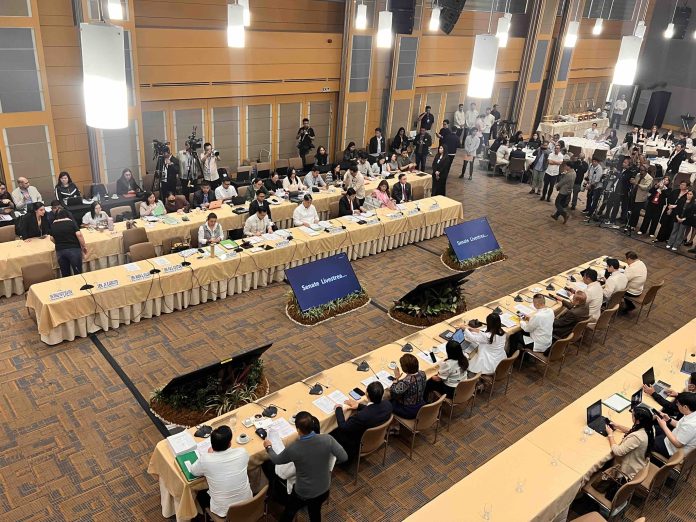
Catholic educators and civil society groups urged lawmakers to reject patronage-driven spending and uphold rights-based governance as bicameral deliberations on the 2026 national budget continue, saying transparency must go beyond livestreamed proceedings.
The Catholic Educational Association of the Philippines (CEAP) welcomed the historic livestreaming of the bicameral budget deliberations, calling it “a meaningful step toward transparency and public participation.”
“For the first time, Filipinos witness the difficult choices and compromises, as well as issues addressed and ignored, that shape public spending,” CEAP said.
The group said it “affirm[s] the prioritization of education through the largest education budget in history and the renewed support for Project NOAH,” describing these as signs of “a commitment to long-term human development, scientific integrity, and the protection of life.”
However, CEAP warned that the proceedings also exposed persistent governance weaknesses.
“The realignment of funds across agencies without fully addressing systemic risks, and the continued reliance on patronage-based mechanisms such as medical assistance coursed through guarantee letters, reveal a troubling truth, that public resources still remain subject to political discretion rather than grounded in rights-based, accountable systems,” it said.
“While immediate assistance to the poor is necessary,” CEAP added, “charity mediated by political favor cannot replace strong public institutions that deliver healthcare, infrastructure, and social protection as a matter of justice.”
Similar concerns were raised by the Caucus of Development NGO Networks (CODE-NGO) in a Dec. 16 statement during the bicameral conference.
“We call on the Filipino people to stand with the Senate version of the Budget Bill,” CODE-NGO said, citing reduced “pork-like allocations in their version, such as ayuda, tulong-dunong, and questionable infrastructure items.”
The group rejected the House version, stating that “as per PCIJ, ⅔ of the DPWH budget are pork-barrel allocations which will greatly benefit the House Speaker, the Chair of the Committee on Appropriations, and her sister’s District.”
While welcoming the livestream as an “unprecedented reform,” CODE-NGO said a genuine open bicameral process must be “accessible, transparent, and participatory.”
“The Filipino people are watching: enough drama, show us good governance!”