A national symposium in Seoul brought youth, scholars, Church leaders, and Vatican officials together on November 15 to examine the realities facing young people as preparations intensify for World Youth Day 2027.
The Catholic University Pastoral Research Institute, working with the Local Organizing Committee (LOC) of World Youth Day Seoul 2027, convened its 29th Academic Symposium to deepen the Church’s understanding of young people and their place in the life of the community.
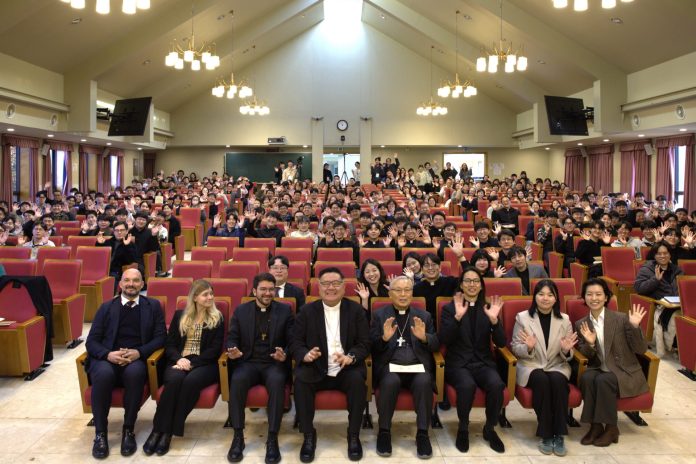
Held under the theme “The Youth and the Church of Our Time, and WYD Seoul 2027,” the gathering drew a notably large number of young adults from across South Korea.
Registration data showed that more than half of all participants were youth in their 20s and 30s, joined by seminarians, clergy, religious, and lay ministers.
Organizers said the turnout reflected a growing commitment within the Church to listen closely to the lived realities and spiritual concerns of young Catholics.
Representatives from the Dicastery for Laity, Family and Life also attended as part of a week-long onsite meeting with the LOC, which signifies the close collaboration between the Holy See and the Korean Church for WYD Seoul 2027.
The Archdiocese of Seoul said the symposium emphasized a synodal approach, with cross-generational commentaries and mixed-age group discussions to explore shared hopes for the Church’s future.
“This symposium holds special meaning because it brings young people and the wider Church together in a seminary lecture hall ordinarily used for priestly formation. Yet today opened to reflect on the lives of our youth,” said Bishop Paul Kyung-sang Lee, General Coordinator of the WYD Seoul 2027 LOC.
The prelate said the symposium “carries profound significance for our community” because it gathers the whole Church to “confront the realities facing young people and to seek solutions together.”
He emphasized that preparing for World Youth Day should start with attentive listening to young people, whose lives and faith form the heart and future of the Church, calling this reflection a vital foundation.
The first presentation, delivered by Rev. Martin Kyu-hyun Jeong, shared findings from the Preliminary Perception Study on Youth for WYD Seoul 2027.
The research included a quantitative survey of 1,973 general youth and 2,278 Catholic youth, alongside qualitative interviews with 10 youth panels and two groups of youth ministry experts.
Organizers described the study as one of the most comprehensive efforts in recent decades to understand how Korean youth—religious or not—perceive society, ethics, and values.
The data is expected to guide pastoral programming in the run-up to WYD.
Dr. Ji-woon Lee presented insights from the Vatican’s International Youth Advisory Body, drawing from her work with young Catholics around the world.
Her talk offered a wider view of how youth interpret current social and ecclesial challenges, including the significance they attach to WYD Seoul 2027.
A third presentation by Na-kyung Cecilia Im and Ji-hye Lucia Jang, both young volunteers with the LOC Spirituality Team, focused on the emotional, social, and spiritual pressures facing the country’s youth.
Their reflections, presented as youth delegates involved in the research process, encouraged pastoral leaders to consider new forms of accompaniment.
Archbishop Peter Soon-taick Chung, Chair of the WYD Seoul 2027 LOC, offered a message of encouragement, describing the concerns of young people as a global reality.
“Across the world—not only in Korea—young people are navigating an era of rapid technological change,” he said.
“While new forms of connection have emerged, many also experience isolation. In this environment, the hopes and dreams of young people hold immense value for the future of the Church, and we must accompany and support them with care,” the prelate added.
He expressed gratitude to the presenters and participants, highlighting the symposium’s long-term pastoral value.
He said that while it could not offer all solutions, it fostered shared reflection, mutual discernment, and collaborative faith, embodying the Church’s synodal journey.
Organizers said the symposium offered a consolidated view of youth experiences that will inform the Church’s pastoral and organizational decisions leading to 2027.
Many participants affirmed that the research and conversations established an essential foundation for shaping programs rooted in authentic youth voices.