A. My journey into Development Work
My personal journey for a life committed to development work started way back during my college years at the Ateneo de Manila University, as a seminarian of San Jose Seminary. During our time, there was an attempt to instill among the students the spirituality of St. Ignatius of Loyola (founder of the Jesuit Order), challenging us to become “men and women for others.” Clearly, the foundation of my activism was not directly based on some ideology, but it was very much grounded in specific Christian spirituality.
I joined the Ateneo Student Catholic Action (AtSCA), a moderate, non-ideological student organization whose goal is to provide spiritual formation and conscientization through immersion or integration with the poor. I remember spending most of my weekends in urban poor communities. I had also been involved in the founding and in the early organizing phase of GOMBURZA, an association involving the religious sector engaged in justice campaigns, following the footsteps of the priest-martyrs of the Philippine Revolution. For me, these were not just extracurricular activities – they were part of my early formation that would later lead me further to my development and social action ministry.
I was ordained to the priesthood on April 1, 1993. That was exactly two years after the Second Plenary Council of the Philippines (PCP II) was convened, setting the desired direction for the renewal of the Church in the Philippines. The document became a second Bible to me, and I had high hopes that our ordination was a timely opportunity to put into action the agenda for renewal, outlined in the document. I was more than enthusiastic, fired by passion and fresh idealism.
The Council particularly addressed this needed renewal in the life of the Church: “Expressing our faith through deeds of justice and love is particularly urgent in the Philippines where the exercise of faith often seems to be restricted to the realm of religious activities and private morality” (PCP II, no. 80).
In our local Church of Oriental Mindoro, where I choose to serve (I am actually from the Diocese of Lucena in Quezon Province), there were initiatives and patches of inspired programs here and there to bring into reality the mandate of the Council. I found myself working with farmers and fisherfolk who bore the weight of poverty, landlessness, and political neglect. Inspired by PCP II’s call for faith and justice integration, we worked with organized sectors, with our programs focused on structural change: agrarian reform, sustainable agriculture, and sectoral empowerment.
During the height of militarization in Mindoro from 2001 to 2003, I was red-tagged and falsely accused of being a DT (dissident terrorist). I was placed on the military’s “order of battle.” I was no. 6 on the list. My bishop was so alarmed that he compelled me to take a study leave.
Since my ordination in 1993, I worked with the Mangyan Mission, in addition to my other pastoral assignments, until I was invited by Bishop Broderick Pabillo to join him in NASSA/Caritas Philippines in 2010. I resigned in 2020, but now I’m back to my home diocese, and I am again in charge of the Diocesan Social Action Center of the Apostolic Vicariate of Calapan.
B. SPIRITUALITY AND HOPE:
A Theological Reflection on the Journey Toward Integral Development
“Hope does not disappoint us . . . Everyone knows what it is to hope. In the heart of each person, hope dwells as the desire and expectation of good things to come, despite our not knowing what the future may bring.” (Spes Non Confundit, no. 1)
Authentic Christian hope stands at the core of our vocation. As commonly expressed in people’s oft-cited cliché: “May awa lagi ang Diyos, nakakaraos din!”
In our work for sustainable development and human dignity, this hope takes concrete form through the Church’s social engagement – in our persistent resistance to systemic injustice, and in our commitment to address the situation of abject poverty and the oppression of the marginalized. Nagsisikap tayong makilakbay sa mga maralita at mga nasa laylayan ng lipunan kaakibat ang alab ng pag-asa at pagtataya.
1. Development as the Kingdom Being Realized
I worked with Bishop Broderick Pabillo during my initial years of leading the National Secretariat for Social Action (NASSA), which later became Caritas Philippines. Our office is the development, advocacy, and humanitarian arm of the Catholic Church. Bishop Pabillo always emphasized that our work in social action ministry must always be faith-based and love-driven. He kept on reminding us that we need to go beyond shallow activism and to consider development work as essentially our way of living our faith – how we make present the in-breaking of the Kingdom of God amidst the struggle for justice and integral development.
Appreciating integral development work through the lens of our faith gives us a more profound perspective. The Kingdom of God is not some distant utopia or merely a heavenly reward in the afterlife. Jesus’ proclamation of the Kingdom means it is already breaking into our world, where the poor are blessed and empowered, the Good News of salvation is proclaimed, dignity is restored, and the integrity of creation is ensured.
The Second Plenary Council of the Philippines (No. 279-280) mandates us to have this kind of spirituality that seeks the Kingdom as the primary rule. We are encouraged to have a kind of spirituality “that shares Good News joy in the midst of deprivation, hope in situations of cynicism and pessimism, a faith that is fully aware of the enduring presence of God-with-us and of the ultimate victory of goodness over evil.”
For pastoral workers in the Church, when we work for integral development with this Kingdom vision in our hearts, we’re doing something deeply spiritual. In the words of Cardinal Luis Antonio Tagle, the work we do is holy; we are doing God’s work, expressing His compassion through our social action ministry.
To proclaim the coming of the Kingdom today means standing shoulder to shoulder with those who are creating an alternative development paradigm – those building just economies, the indigenous communities defending their ancestral lands, and all who are working for just, real, and lasting peace. It means re-imagining the Church’s mission, not just giving aid or charity, but walking with the poor, empowering them, and joining them in their efforts to transform unjust structures.
2. The Promise of the Resurrection: Hope in the Midst of Struggle
Spes Non Confundit (no. 20) invites us to reflect on the message and meaning of the Resurrection as basis for our hope: “The death and resurrection of Jesus is the heart of our faith and the basis of our hope . . . Buried with Christ in Baptism, we receive in his resurrection the gift of a new life that breaks down the walls of death, making it a passage to eternity.”
Believing in the Resurrection means we share this conviction – that when everything appears hopeless, we continue to believe that the story is not over. Although the Resurrection does not deny pain, failure, and suffering, it tells us that God is at work, even in the most difficult situation of utter hopelessness. In the face of systems that exploit the poor and destroy the earth, we continue to hope, not because we expect that success is always guaranteed, but because we believe in a God who journeys with us through suffering, who brings life out of death.
When we see worsening climate disasters, widening inequality, brutal killings, and the ever-continuing political dysfunction, collapsing institutions, and failed state governance, it’s easy to grow tired or be terribly disappointed. But Christian hope doesn’t allow us to give in. It is because hope is not only a shallow feel-good message, it’s a courageous and stubborn faith that keeps us hoping despite the seeming failures and insurmountable difficulties.
Yes, the work in pursuing genuine development is often marked by painful struggles, setbacks, and persistent challenges, especially for those who stand up to power and struggle against injustices. Communities that defend their ancestral lands, environmental defenders that speak out against destructive mining, often face threats, harassment, and even violence. But it is precisely in these moments of harrowing struggle that Christian hope prevails.
As my favorite poem, attributed to Archbishop Oscar Romer,o invites us to believe:
The kingdom is not only beyond our efforts, it is even beyond our vision. We accomplish in our lifetime only a tiny fraction of the magnificent enterprise that is God’s work. Nothing we do is complete, which is a way of saying that the Kingdom always lies beyond us.
3. Salvation: Life in Its Fullness
In the Bull of Indiction, Spes Non Confundit (no. 15), Pope Francis personally make an appeal to the Church: “I ask with all my heart that hope be granted to the billions of the poor, who often lack the essentials of life. Before the constant tide of new forms of impoverishment, we can easily grow inured and resigned. Yet we must not close our eyes to the dramatic situations that we now encounter all around us, not only in certain parts of the world.” (no 15).
This exhortation resonates with Jesus’ proclamation, “I came that they may have life, and have it to the full” (John 10:10), show us that God’s desire is not just for our salvation in the afterlife, but for our well-being here and now – in every part of our lives: physical, spiritual, social, and even ecological. That’s why the Church is deeply involved in the work of development – helping people live with dignity, fight poverty and injustice, and experience the fullness of life that God wants for everyone.
It is for this reason that the idea of sustainable development and well-being is so important. It gives us a real, grounded way to imagine what “life in its fullness” could mean in concrete terms. It’s not just about GDP or economic growth. It is about people having a sense of solidarity, healthy ecology, a peaceful relationship with nature, good governance, and a deep spiritual grounding. This is not far from what the Bible calls shalom, a state of wholeness where everything and everyone is in right relationship, and no one is left behind. In this light, salvation is not just a future hope. It is a present calling – to live in ways that bring healing, justice, and fullness of life to all of God’s creation.
Development among the Mangyan indigenous peoples refers more to the promotion of the well-being of the social community and the ecosystems, which is an utter contrast to the prevailing neoliberal economic model. This kind of development model emphasizes that financial growth is not the sole and real measure of development. This development paradigm demands that a more integrative model takes into account the inseparable link between human and ecosystem well-being.
C. PASTORAL CHALLENGES:
SUSTAINING HOPE, RENEWING OUR MISSION
The Gospel is never meant to provide a comprehensive development blueprint or to directly impose any political agenda, but it does offer a deeply challenging vision of what dignified life is all about, a vision for the common good and the needed transformation as a result of genuine conversion and living out the Gospel imperatives
1. Challenging the Prevailing Model of Development
The prevailing “development” paradigm accelerates the creation of wealth among the capitalist elites who control the world economy, while ironically it results to ever ever-widening disparity and ever-deplorable massive poverty among the basic sectors of society. Development in the neo-liberal market economy was proven to be the cause of and not the solution to the worsening problem of poverty and social imbalances at all levels, between the rich and the poor, the lower-growth and the higher-growth economies. This crisis of inequity and limitless growth output leads to a crisis of unsustainability, already being experienced in forms of conflict, social breakdown, extreme poverty, global competition for resources, transnational oligarchy, and chronic political instability.
Laudato Si (no. 194) calls for a re-evaluation of the prevailing models of global development and a redefinition of our notion of progress so that it can truly serve the common good, particularly the poor and the excluded. The encyclical is categorical in describing the irony of the so-called development vis-à-vis the resulting poverty and exclusion of the people: “A technological and economic development which does not leave in its wake a better world and integrally higher quality of life cannot be considered progress. Frequently, in fact, people’s quality of life actually diminishes . . . in the midst of economic growth.”
The impact of this distorted notion of development is experienced by our local Church in Mindoro, where corporate greed drives the indigenous peoples out from their ancestral lands and subjects the communities to further poverty and misery. The growth in the global economy has accelerated the intrusion of transnational mining corporations into the forest lands and critical watersheds. The subjugation of the indigenous peoples to corporate greed has been continuing, and it is now beautifully packaged as an offer for “development” in terms of millions in dole-outs and monetary incentives.
We are called to transform the mainstream narrative and push for alternative development paradigm: “For a new models of progress to arise, there is a need to change ‘models of global development,’ this will entail a responsible reflection on ‘the meaning of the economy and its goals with an eye to correcting its malfunctions and misapplications.’” (LS, no. 194)
2. Development Work and Integrated Spirituality
It was Pope John Paul II, in his encyclical Sollicitudo Rei Socialis, who himself affirmed that the work for development is part of our Christian vocation: “ . . . peace and, as its necessary condition, the development of the whole persons and of all peoples, are also a matter of religion, and the full achievement of both the one and the other depends on our fidelity to our vocation as men and women of faith . . .”
Development work, when separated from spiritual depth, can easily become just another aid program dictated by results-based deliverables for funding reports. But authentic development is not simply about infrastructure, livelihoods, or income levels – it is about human dignity, socio-political transformation, justice for the marginalized, and the survival of both people and threatened ecosystems. This is where integrated spirituality becomes indispensable.
The PCP II (no. 188) defines integrated spirituality as “ . . . spirituality that unites faith in the Lord with justice and charity to His brothers and sisters and joins together a HOPE for the world to come with an intense commitment to transform the world . . . a spirituality that seeks for change not only in interior attitudes but in ecclesial and societal structures.”
This kind of spirituality is imperative for the Church in the Philippines because “while the majority of our people are Catholics and our churches are filled on Sundays, our society remains a sick society.” (PCP II, no. 192).
Pope Francis found this kind of spirituality unacceptable, if not at all, detestable: “No one can demand that religion should be relegated to the inner sanctum of personal life, without influence on societal and national life . . . An authentic faith . . . always involved a deep desire to change the world” (Evangelii Gaudium, no. 183).
3. Church of the Poor and Political Advocacy for Transformation
This is how the PCP II (no. 131) defines what is expected of Church of the Poor: “Before today’s forms of exploitation, the Church cannot remain silent . . . Pastors and members of the Church will courageously defend and vindicate the rights of the poor and oppressed, even when doing so will mean alienation or persecution from the rich and powerful.”
But denouncing injustice is not enough. For real transformation to take place, there should be concrete political engagement, by way of exercising the Church’s prophetic ministry. Without engaging in socio-political spheres, our words and pastoral statements will remain hollow and ineffective. In the commentary to the encyclical Octogesima Adveniens, it is affirmed that: “ . . . it is not enough to recall principles of action, to point out injustice, and to utter pious words of denunciation; such words lack meaning unless they are accompanied by responsible political and social action.”
The CBCP, in its Pastoral Exhortation on Philippine Politics, admitted the need to change our political culture if we are to address the issue of poverty and maldevelopment: “If we are what we are today – country with a very great number of poor and powerless people – one reason is the way we have allowed politics to be debased and prostituted to the low level it is in now.”
And the Church cannot remain a fence-sitter or an indifferent bystander. There are many ways in wherein people can create a critical mass to transform the self-serving political paradigm and structure into a pro-people, pro-poor government, to pursue the Gospel-driven agenda in regard to the common good, human dignity, justice, and ecological conversion. The PCP II (no. 344) mandate is very categorical: “Concretely, this means BOTH clergy and laity must be involved in the area of politics when moral and Gospel values are at stake.”
Pope Francis, in his encyclical, Fratelli Tutti (no. 180), acknowledges that politics is not bad per se (as many people would assume). On the contrary, it can be construed as a noble exercise of love for neighbor – “a lofty vocation and one of the highest forms of charity, inasmuch as it seeks the common good.”
4. “The Cry of the Earth is the Cry of the Poor”
In the encyclical, Laudato Si (no. 5), Pope Francis is advocating for a fundamental transformation in our perspectives and principles regarding how we relate to Earth’s environment. He writes that “an ecological conversion is needed to bring about lasting change . . . it demands that we recognize our responsibility to ourselves, to others, and to the world around us.”
This is the reason why we consider Laudato Si as a breakthrough, a radical and revolutionary document which dramatically makes a paradigm shift from anthropocentric theology to a more eco-centric perspective, underlining the “immensity and urgency of the challenge we face” vis-à-vis climate change, mass extinction, unprecedented biodiversity loss, and the impacts of environmental degradation on the poor.
This powerful insight from the encyclical clearly points out the inseparable link between ecological destruction and its impact on the poor and the most vulnerable. In many rural and indigenous communities in the Philippines, this connection is not abstract; it is painfully real. When forests are destroyed and rivers are poisoned by mine tailings, when the marine ecosystem is contaminated due to the proliferation of gas-fired power plants, it is the poor who suffer first and most. Environmental degradation is not just an ecological issue. For the impacted communities, it is a matter of survival, and an outright violation of human and nature’s rights.
For the Church, the pastoral response must integrate ecological concern with the development work of our social action in the respective dioceses. This means rethinking how our parish communities function: Can our church lands become models of sustainable agriculture, especially in the provinces? Can our formation programs in our Catholic schools teach ecological justice as central to the Gospel? Can we in the Church, including clergy and lay leaders, become prophetic voices in resisting ecological sin?
D. CONCLUDING REFLECTION:
As an activist priest, a development worker, and someone who’s been part of many struggles for justice, I hold on to this assurance: “Therefore, my beloved brothers and sisters, be firm, immovable, always excelling in the work of the Lord, knowing that your labor is not in vain in the Lord.” (1 Cor 15:58).
As we reflect on the journey of faith, justice, and development, we’re reminded that hope is about seriously doing our Christian mission and responding to God’s call to bring Good News to the poor.
Pope Francis puts it beautifully in Spes Non Confundit (no. 3): “By his perennial presence in the life of the pilgrim Church, the Holy Spirit illumines all believers with the light of hope. He keeps that light burning, like an ever-burning lamp, to sustain and invigorate our lives. Christian hope does not deceive or disappoint because it is grounded in the certainty that nothing and no one may ever separate us from God’s love.”That message of hope gives us strength. As a Church of the Poor, walking side by side with the least and the marginalized, we move forward in hope, believing that every act of compassion, every advocacy for justice, for human and nature’s rights, brings us a step closer to the realization of God’s will: I have come that they may have life, and life to the full (John 10:10).
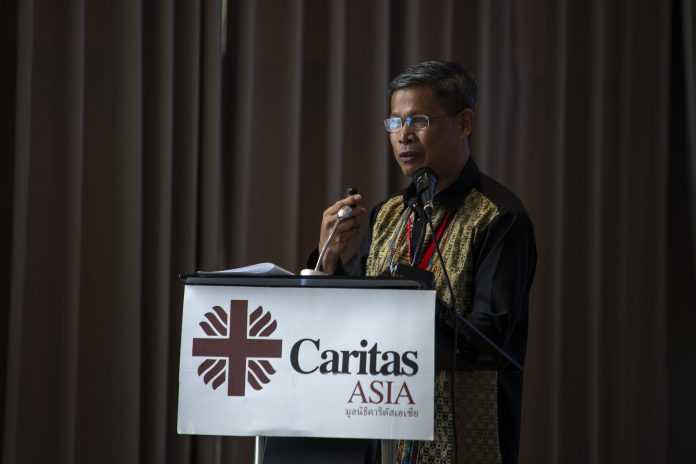
Fr. Edwin “Edu” Gariguez was the former executive secretary of Caritas Philippines. In 2012, he was awarded the Goldman Environmental Prize for leading a grassroots movement against an illegal nickel mine to protect Mindoro Island’s biodiversity and its indigenous people. He is currently the social action director of the Apostolic Vicariate of Calapan.