The greatest force in the world is one that attracts and brings people and things together—one that created the Earth and affects everyone, for good or bad. This force can unite and strengthen bonds. The closer they are, the stronger and greater the force.
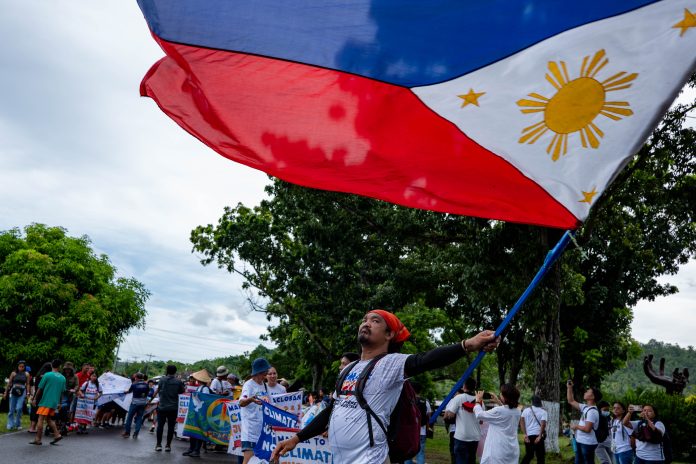
Commitment, dedication, and love of neighbor and creation are spiritual forces we see today in our young people who are fighting for climate justice and protecting the environment.
In calling for climate justice, these young heroes are actively protecting the environment and advocating for the Philippines to take more action and put the welfare of people ahead of profit.
Greenpeace Philippines has recognized some of these environmental heroes, including Jefferson Estela of Youth Strike for Climate. He has called for greater participation of the youth in national decision-making and led his organization in advancing its goal of combating climate change.
Also recognized is Sophia Caralde, Youth Strike 4 Climate Philippines’ education and research committee head. She works to raise awareness among the youth to solve the climate crisis and challenges Philippine government officials to respond to the call for lower carbon dioxide (CO₂) emissions.
Also working for climate justice is Bill Bontigao, president of the Bicol University Science Alliance Club, who called on government officials to take action and have the political will to declare a national climate emergency.
It is through knowledge and science that we—and the youth—can understand the forces at work in the universe that affect our world and our lives. It is not just a matter of bad weather. There are two massive forces driving climate change: nature and people.
The most powerful physical force in nature is, of course, gravity. This is the force responsible for our continued existence because it affects the global climate and holds the atmosphere together. That is the basis of all life—your life, your child’s, the community’s, the planet’s.
Perhaps of equal importance is that gravity exerts force on atmospheric density and ocean currents, on the distribution of water on the planet that affects global cooling or warming. Since 71 percent of the planet’s surface is covered with water, and about 96.5 percent of all this water is in the oceans, it has a powerful effect on the world’s climate.
No Longer Stable
When we gaze at the night sky and see the moon, we know that gravity is attracting the moon to the Earth. That has a powerful effect on our climate too, because it causes the tides—the rise and fall of the oceans. More than that, the force of gravity on the moon helps stabilize the Earth’s axial tilt. This is what creates the seasons, allows for a stable climate, and enables us to grow food to survive. Nowadays, the planet’s climate is no longer stable. We humans, the rational and intelligent species, after a billion years, have done something to change that once-stable, ordered, and disciplined relationship with nature—affecting the entire planet and the lives of all living creatures.
About 265 years ago in England, a few people—out of a world population of 1 billion at the time—began the Industrial Revolution, which was driven by fossil fuels. That has not stopped since. This has ultimately resulted in global warming, which is having a catastrophic impact on all living things. This is a most terrible, unforeseen consequence, because hundreds of millions of people are suffering and dying from droughts, floods, typhoons, storms, crop failures, heatwaves, and pollution. Many animals and plants are facing extinction.
These are the concerns of young climate justice activists today. They have alerted world leaders to this grave danger, and international agreements have been reached among nations to phase out fossil fuels and expand renewable energy alternatives like wind and solar power. But this is not enough. The danger is growing, and the climate crisis will soon reach a point of no return.
The biggest producers of greenhouse gas emissions—including CO₂ and methane—are China, the United States, and some European nations. Other significant contributors include India, Russia, and Japan. In the Philippines, there were 64 existing coal-fired power plants connected to the main grid as of December 2024. San Miguel Global Power, AboitizPower, Manila Electric Co., Therma Luzon Inc., Therma South Inc., and Therma Marine Inc. all use coal and oil for electricity generation. Renewable energy (RE) generators such as solar plants and some wind turbines are far from replacing coal and oil.
Surveys conducted worldwide show that, out of 10,000 young people between the ages of 16 and 25, a shocking 60 percent said they were very worried about the effects of climate on their future. The United Nations has warned that more dangers lie ahead as higher temperatures are recorded. The latest forecast from the World Meteorological Organization indicates that there is an 80-percent likelihood that the world will see its annual average global temperature exceed 1.5 degrees Celsius above pre-industrial levels for at least one of the next five years.
People are taking a stand to push and advocate for more serious action to limit CO₂ and methane emissions that cause global warming. In the Philippines, there is Youth Advocates for Climate Action Philippines (YACAP), a coalition of environmental youth organizations where young people are taking a stand. YACAP is organizing young people to lead the global action against the climate crisis. They said:
“With the Philippines ranking as one of the most vulnerable places on Earth impacted by climate change, it is imperative for us to declare a climate emergency as defined by the people and have concrete plans on addressing the current and the possible future effects of this climate crisis.”
These are just a few of the young heroes we can be proud of—and there are many thousands more doing their share in making the Philippines a safer and environmentally healthy place to live.
Note: Any original information, stories, or news articles posted on this site that are authored by the Preda Foundation and Father Shay Cullen may be shared, copied, or reproduced without further permission, in support of truth, freedom of expression, and the public’s right to know.
LiCAS News was granted permission to republish and adapt this article by Father Shay Cullen in the spirit of truth-telling and the pursuit of justice.
Irish missionary Father Shay Cullen, SSC, founded the Preda Foundation in Olongapo City in 1974 to promote human rights and the rights of children, especially victims of sexual abuse.
The views expressed in this article are those of the author and do not necessarily reflect the editorial stance of LiCAS News.