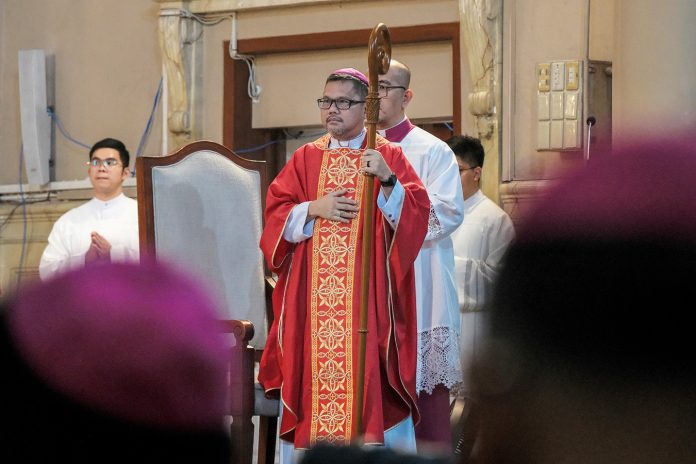
A Catholic bishop has warned that renewable energy projects in the Philippines must not sacrifice Indigenous Peoples’ rights, local livelihoods and the environment for corporate profit.
Bishop Dave Dean Capucao of Infanta called for closer scrutiny of wind and solar energy projects in Quezon and Aurora provinces, warning that the transition away from fossil fuels must not reproduce existing patterns of exploitation and inequality.
In a pastoral letter addressed to poor communities in the Prelature of Infanta, Capucao said renewable energy development must protect ancestral lands, ecosystems and local livelihoods while ensuring that affected communities share in its benefits.
“We do not oppose renewable energy; we oppose an energy transition that sacrifices people, indigenous communities, ecological integrity, and the common good in the name of corporate profit,” Capucao wrote.
The prelate identified wind energy projects in Real, Infanta, and General Nakar in Quezon province, as well as solar farms in Dingalan, Aurora, as developments requiring careful assessment of their potential social and environmental impacts.
He called for scrutiny of their effects on forests, biodiversity, ancestral lands, water resources, agriculture and the livelihoods of Indigenous Peoples and other local communities.
Capucao warned against what he described as “green capitalism,” in which the language of sustainability and climate action could be used to justify land displacement, environmental destruction and the concentration of economic benefits among large corporations.
He said renewable energy projects must serve the common good rather than primarily advance the interests of corporations and investors.
The bishop emphasized that Indigenous Peoples, farmers, fisherfolk and other vulnerable communities must not lose their land, livelihoods or security to make way for energy projects that primarily benefit wealthier sectors.
He called for meaningful community participation in decisions affecting local resources and stressed the importance of free, prior and informed consent (FPIC) for Indigenous communities whose ancestral domains could be affected.
Capucao said affected communities must receive adequate information and be allowed to express support or opposition without coercion.
He also urged developers and authorities to assess each project individually, taking into account environmental impact assessments, locations, agreements, consultations and the experiences of affected communities.
The pastoral letter raised concerns about waste from renewable energy technologies and the extraction of minerals such as cobalt and nickel, questioning whether the demand for these resources could encourage practices that disregard Indigenous communities.
Drawing on Catholic social teaching and Pope Francis’ encyclical Laudato Si’, Capucao said environmental protection and human dignity must remain central to energy development.
He acknowledged the importance of renewable energy in addressing the climate crisis but warned that changing energy sources alone would not resolve existing social and ecological injustices.
The bishop urged the Church to defend marginalized communities, protect the environment, and challenge development policies that place corporate interests above human dignity and the common good.
“A truly green energy transition must also be a just energy transition,” Capucao wrote.