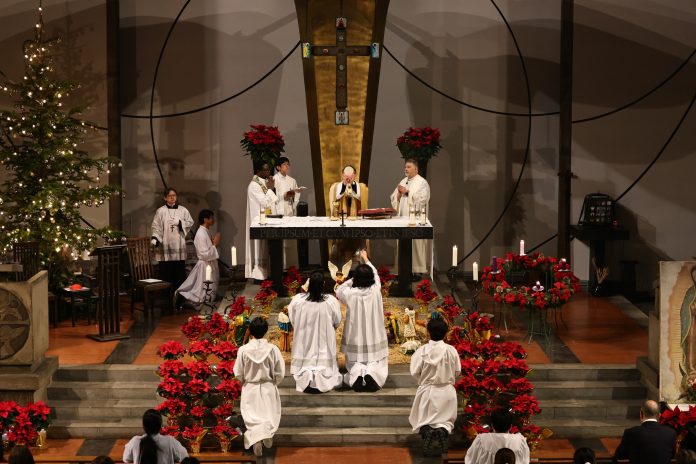
Cardinal Isao Kikuchi of Tokyo called for concrete action and shared responsibility amid ongoing global violence and humanitarian crises during the 2025 Simbang Gabi (pre-dawn) Mass at Catholic Meguro Church.
The prelate delivered the homily as the Catholic Church approaches the close of the Jubilee Year of Hope, which will conclude with the closing of the Holy Door at St. Peter’s Basilica on Jan. 6.
Kikuchi challenged the faithful to reflect on whether the Jubilee theme had been translated into daily life or remained merely symbolic.
“Over the course of this past one year, during this Jubilee Year, how have you reflected on this theme, ‘Pilgrims of Hope’ and how have you acted or what was you actual action to realize this theme in your daily life?” he said. “Or it was just yet another official phrase from the Church which has no meaning in your life?”
Kikuchi said the theme points to two essential realities of Christian faith: that believers are pilgrims and that hope is central to their witness.
Citing the Second Vatican Council, he emphasized that the Church is not primarily a structure but a community journeying together through a troubled world.
“So we are not a group of people just gathering in a church building for worship but we are people of God journeying together, journeying through this reality of troubled world,” he said.
He stressed that faith is lived communally and not in isolation, linking the pilgrim identity of the Church with synodality.
“We do not travel alone, we do not practice our faith in isolation; rather, we are pilgrims who walk together as one community,” he said.
The cardinal situated his call to hope within the context of widespread suffering, pointing to the pandemic and armed conflicts that continue to claim lives and displace communities.
“Over these past several years, the world has been drawn into darkness by the pandemic and by armed conflicts such as war in Ukraine, genocide in Gaza, and many other incidents in which human lives are taken away violently,” he said.
He said the protection of life and respect for human dignity are moral imperatives rooted in faith. “Protecting all life, respecting human dignity, and assisting each other is not our choice to make, but it is a command engraved on our hearts,” Kikuchi said.
Against this backdrop, he framed Christmas as the emergence of light amid darkness, centered on the vulnerability of the Christ child. “Christmas is the celebration of a small light shining in the darkness,” he said.
“The child who was born, though he is the Son of God, was a small and fragile life,” Kikuchi added. “Yet the light of that small life became a great light of hope, bringing salvation to the world.”
While material assistance can save lives, Kikuchi said hope itself cannot be treated as a commodity. “We can help those who are in need by giving them material things,” he said. “But hope itself cannot be brought as hope is not material goods.”
Instead, he said hope grows through encounter and accompaniment. “Our mission is to be pilgrims who sow the seeds of hope,” he said, stressing that this responsibility continues beyond the Jubilee Year.
The Mass formed part of Simbang Gabi, also known as Misa de Gallo, a pre-Christmas devotional tradition that originated in the Philippines during the Spanish colonial period as a pastoral accommodation for farmers who began work before dawn.
Over time, it developed into a nine-day series of early morning Masses leading up to Christmas and became a defining feature of Filipino Advent practice, marked by communal worship, perseverance, and joyful anticipation of the Nativity.
Beyond the Philippines, Simbang Gabi is now observed in various parts of the world, particularly where Catholic communities have carried the tradition into new contexts.
In such settings, the dawn liturgies continue to serve as a space for prayer, continuity of faith, and communal support during the Advent season.
Kikuchi closed by calling on the faithful to examine their daily encounters and the values they cultivate. “So ask yourself today, in your encounters with others in real life, what kinds of seeds have you sown?” he said. “Let us be pilgrims who continue to sow the seeds of hope.”