

The Diocese of Agats has cancelled the 38th Asmat Pokman Art Festival (FAP), Indonesia’s oldest Papuan cultural celebration, following an incident of violence against two key organizers in August.
The decision, signed by Agats Bishop Aloysius Murwito OFM on September 9, halted preparations for the October 2025 edition of the festival, which has been held annually since 1981 in collaboration with the Asmat Regency Government.
Roots of the festival
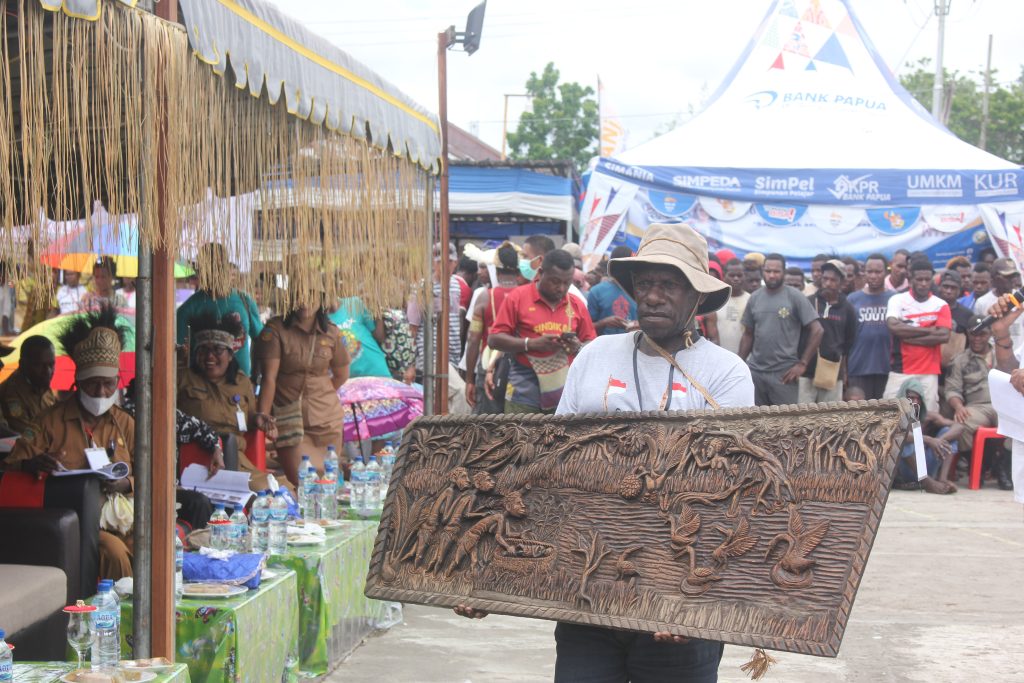
The Asmat Pokman Art Festival was first held in 1981 through the initiative of Bishop Alphonse August Sowada OSC (1933–2014), the first bishop of the Diocese of Agats and a Minnesota-born Crosier missionary.
A cultural anthropologist, Bishop Sowada became known for teaching himself the Asmat language, working to abolish headhunting practices, and preserving the Asmat people’s traditions through art and woodcarving.
Sowada co-founded the Asmat Museum of Culture and Progress in Agats and later established the American Museum of Asmat Art in Minnesota, which since 2012 has been housed at the University of St. Thomas in St. Paul.
‘More than just an art celebration’
According to John Ohoiwirin, head of the Asmat Museum of Culture and Progress, the festival has become a vital platform for cultural resilience.
“This festival is not just an art celebration, but also a space for the Asmat people to showcase their traditions — woodcarving, weaving, music, and rituals. More than that, FAP has become a cultural resistance against external pressures that once eroded Asmat traditional values,” he explained to LiCAS.
In the Asmat language, “Pok” means “work” and “man” means “hand,” making “Pokman” a direct reference to handmade creations.

Preservation and resistance
The festival traces its roots to Bishop Sowada’s 1962 discovery that Asmat youth were abandoning traditional woodcarving under pressures of modernization and industrial logging.
Together with curator Abraham Kuruwaip, Sowada introduced carving competitions to encourage younger generations to continue the practice.
Cultural researcher Yuvens Biakai, later Regent of Agats, recorded that logging and state policies disrupted the transmission of traditional knowledge, leaving carving in danger of extinction.
Former Crosier priest Albertus Istiarto, who served in Agats from 1981 to 1985, recalled that “at one point, while I was working in Agats, I was interrogated in the provincial capital Jayapura, because the Diocese sided with the Asmat people.”
His testimony highlights the tensions between the Church and authorities over resource exploitation, which also drew the attention of Kompas journalist Rudy Badil.
The reporting led to Jakarta exhibitions of Asmat carvings, supported by public figures such as Jakob Oetama, Emil Salim, and Ciputra.

Violence and cancellation
Despite its growth into an internationally recognized celebration of Asmat identity, this year’s festival was derailed by internal conflict.
On August 16, Ohoiwirin and Father Lukas Lega Sando Pr were attacked by a group of artists opposed to long-standing rules banning consecrated ritual carvings from competition.
The regulation, in place for decades, was designed to protect sacred objects believed to embody spiritual presence.
The attack forced the Diocese to cancel the 38th festival, marking a rare disruption in more than four decades of uninterrupted celebrations.
The cancellation halts one of South Papua’s most enduring cultural events.
Ohoiwirin said the festival aims to promote Asmat traditions through visual and narrative presentations, build a comprehensive record of the community’s cultural dynamics, highlight works of art and historical documentation as part of Papua’s heritage, and strengthen pride in local traditions amid modernization.